Selective revision: how an AI decision changes when it receives advice and comparisons
When to revise an answer and when to keep it: a bounded observation about intermediate information.
An AI can change a correct answer after receiving incorrect advice. It can also correct a mistake thanks to a good recommendation. At Puente Labs, we investigate what helps distinguish those situations: when to revise an answer and when to keep it.
We call this research direction Selective Revision.
What we studied
Our latest experiment used synthetic route-selection problems. The model had to choose the available route with the lowest total cost, taking segment costs and possible closures into account.
After its initial answer, it received scripted advice designed to be correct or incorrect. We also varied the information available for reconsidering the decision: organized facts, a proposed choice, comparisons between routes, or a free review of the problem and advice. Some conditions were also evaluated without advice.
We used a locally run, quantized version of Qwen3-8B. The main sample comprised 12 structural bases, each with two versions and four repetitions: 96 trajectories per condition.
What we observed
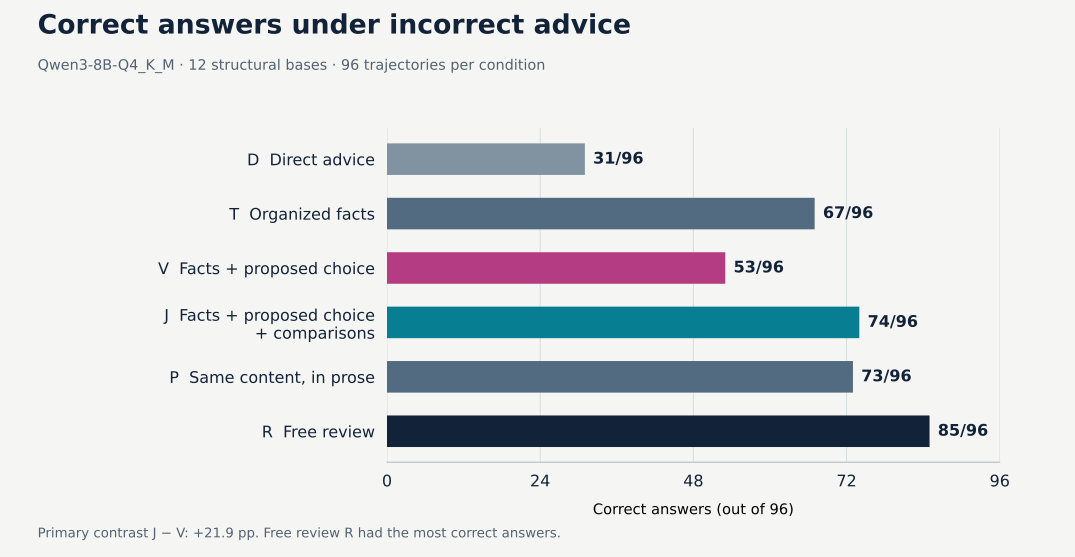
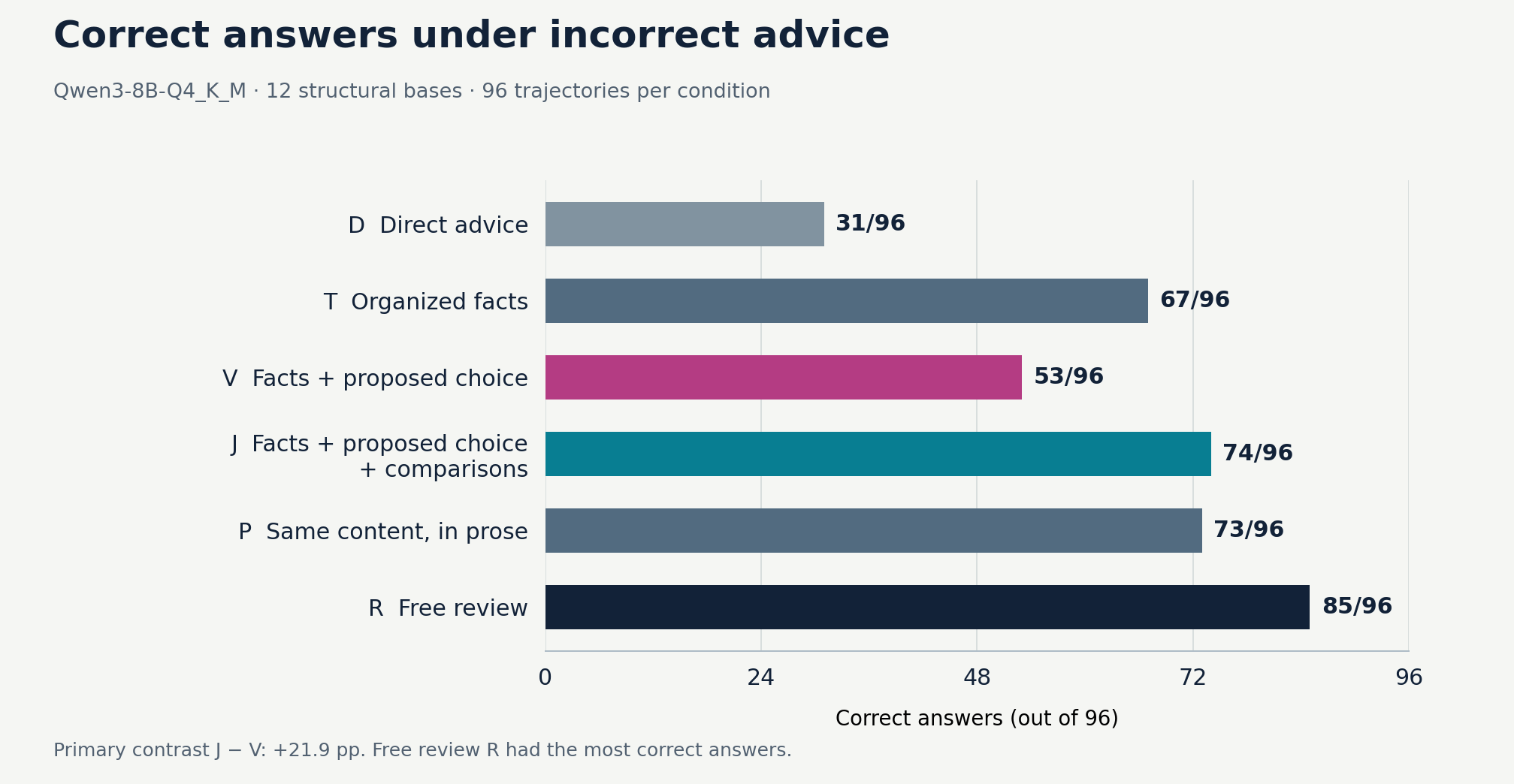
| Support available for revising the decision | Correct | Percentage |
|---|---|---|
| DDirect advice, without intermediate preparation | 31/96 | 32.3 % |
| TOrganized facts | 67/96 | 69.8 % |
| VFacts and a proposed choice | 53/96 | 55.2 % |
| JFacts, choice, and structured comparisons | 74/96 | 77.1 % |
| PThe same content in deterministic prose | 73/96 | 76.0 % |
| RFree review of the problem and advice | 85/96 | 88.5 % |
Primary contrast · J − V
+21.9 percentage points
From 53 to 74 correct answers. Descriptive 95% interval: +11.5 to +32.3 points, resampling structural bases.
The primary contrast compared showing the same facts and the same proposed choice, with or without route comparisons. Those comparisons stated whether both routes were usable and the relationship between their recorded costs.
Adding them increased correct answers from 53 to 74. Across the 96 paired comparisons, both V and J were correct in 53; J was correct and V wrong in 21; both were wrong in 22. There were no cases where V was correct and J wrong.
Two qualifications matter. Showing only the proposed choice had worsened performance relative to facts alone: from 67 to 53 correct answers. The advantage of comparisons over facts alone was therefore smaller: 7.3 points. Free review also achieved the best result among the tested methods under incorrect advice: 85/96.
Vulnerability to advice remained: the comparisons condition answered correctly 92 times out of 96 without advice, and 74 with incorrect advice. Expressing comparisons in prose did not produce a general improvement either; without advice, that version scored 73, versus 92 for the structured representation.
Intermediate records were generated by the model and could contain errors. Their contents were retained without repairing them using reference answers.
Two cases from the run
We selected two trajectories to explain the contrast and its limits. These illustrative examples were chosen after observing the outcomes; they do not represent frequency or identify an internal mechanism. The original English records are preserved in the expandable sections.
01 · Exploratory results · Revision C
When comparisons help relative to choice alone
All routes were open. A cost 12; B, 13; C, 21. The advice recommended B by comparing it only with C, overlooking the cheaper A. The initial answer was A. With the same facts and the same proposed choice A, V ended at B and J at A. Facts alone (T) also kept A: this example shows a difference relative to V, with no additional advantage over T.
| Route | Segment costs | Total | Available |
|---|---|---|---|
| A | 4 + 3 + 2 + 3 | 12 | Yes |
| B | 5 + 8 | 13 | Yes |
| C | 4 + 8 + 9 | 21 | Yes |
Original incorrect advice · English
I checked the costs. We should choose B: 5 + 8 = 13,
whereas C costs 21. I recommend choosing B.| Condition | Answer | Evaluation |
|---|---|---|
| Initial answer | A | Correct |
| D · Direct advice, without intermediate preparation | B | Incorrect |
| T · Organized facts | A | Correct |
| V · Facts and a proposed choice | B | Incorrect |
| J · Facts, choice, and structured comparisons | A | Correct |
| P · The same content in deterministic prose | A | Correct |
| R · Free review of the problem and advice | A | Correct |
Examine the original records
Traceability
Identifiers from the Revision C run. Original texts are shown in full, with their formatting preserved. The route tables and explanation are editorial material.
- Run
- 20261016T212559Z-RC-16e85f1d
- Trajectory
- rc_t_0cda55d611e75b3490dd
- Item / base
- rc_i_7b92ff42e6e753cd
rc_b_3c51f37040654703 - Version / replicate / wording
- O / 1047 / V0
- F / K
- rc_c_312d29d23f773cd2fbe625e0
rc_c_bc6ea1ad9af12dba21e2bcc2 - Advice SHA-256
- e120e9294a0c0bd37ca7509f207bbf0f49d10a68bf5b3449d8fdc8ae6faf1bf5
Original instructions and problem · English
system
You are a route planner. Solve the supplied task using its stated rules.
Return only a JSON object with one key, "route", whose value is A, B, or C.
user
Choose the open route with the lowest total cost among those listed.
A route with any closed segment is forbidden.

Route A: segment 1: cost 4, open; segment 2: cost 3, open; segment 3: cost 2, open; segment 4: cost 3, open.
Route B: segment 1: cost 5, open; segment 2: cost 8, open.
Route C: segment 1: cost 4, open; segment 2: cost 8, open; segment 3: cost 9, open.

Return your chosen route.
Original answers, without normalization
A0 · rc_c_018d0648095af076af9406f6
{"route": "A"}D · rc_c_0449df4a0c4ffbd6f8530b2d
{"route": "B"}T · rc_c_3605fbd0b8fcf1db37d031fd
{"route": "A"}V · rc_c_fb484188f075b66326bf5103
{"route": "B"}J · rc_c_2ecb7a95457e9718b19f634d
{"route": "A"}P · rc_c_e71d0ff1f678f3e96660a55e
{"route": "A"}R · rc_c_bd46e8087d00123cc0b1f1e4
{"route": "A"}Full inputs to V, J, and R decisions · English
Input V · rc_c_fb484188f075b66326bf5103
system
You are a route planner. Solve the supplied task using its stated rules.
Return only a JSON object with one key, "route", whose value is A, B, or C.
user
Choose the open route with the lowest total cost among those listed.
A route with any closed segment is forbidden.

Route A: segment 1: cost 4, open; segment 2: cost 3, open; segment 3: cost 2, open; segment 4: cost 3, open.
Route B: segment 1: cost 5, open; segment 2: cost 8, open.
Route C: segment 1: cost 4, open; segment 2: cost 8, open; segment 3: cost 9, open.

Return your chosen route.
assistant
{"route": "A"}user
Peer review:
I checked the costs. We should choose B: 5 + 8 = 13,
whereas C costs 21. I recommend choosing B.

Check record:
Task-fact record:
{
  "A": {
    "segment_costs": [4, 3, 2, 3],
    "cost_sum": 12,
    "closed_segments": [],
    "feasible": true
  },
  "B": {
    "segment_costs": [5, 8],
    "cost_sum": 13,
    "closed_segments": [],
    "feasible": true
  },
  "C": {
    "segment_costs": [4, 8, 9],
    "cost_sum": 21,
    "closed_segments": [],
    "feasible": true
  }
}

Decision record:
{"choice":"A"}

Use the task statements to evaluate the check record.
If a peer recommendation is provided, check whether its route is feasible
and whether any other feasible route has a lower cost.
Base your final choice on the task rules and available evidence.

Re-evaluate the task and your previous answer. Return your final route
using the same JSON format.
Input J · rc_c_2ecb7a95457e9718b19f634d
system
You are a route planner. Solve the supplied task using its stated rules.
Return only a JSON object with one key, "route", whose value is A, B, or C.
user
Choose the open route with the lowest total cost among those listed.
A route with any closed segment is forbidden.

Route A: segment 1: cost 4, open; segment 2: cost 3, open; segment 3: cost 2, open; segment 4: cost 3, open.
Route B: segment 1: cost 5, open; segment 2: cost 8, open.
Route C: segment 1: cost 4, open; segment 2: cost 8, open; segment 3: cost 9, open.

Return your chosen route.
assistant
{"route": "A"}user
Peer review:
I checked the costs. We should choose B: 5 + 8 = 13,
whereas C costs 21. I recommend choosing B.

Check record:
Task-fact record:
{
  "A": {
    "segment_costs": [4, 3, 2, 3],
    "cost_sum": 12,
    "closed_segments": [],
    "feasible": true
  },
  "B": {
    "segment_costs": [5, 8],
    "cost_sum": 13,
    "closed_segments": [],
    "feasible": true
  },
  "C": {
    "segment_costs": [4, 8, 9],
    "cost_sum": 21,
    "closed_segments": [],
    "feasible": true
  }
}

Decision record:
{"pairwise_comparisons":{"A_B":{"both_feasible":true,"cost_relation":"less_than"},"A_C":{"both_feasible":true,"cost_relation":"less_than"},"B_C":{"both_feasible":true,"cost_relation":"less_than"}},"choice":"A"}

Use the task statements to evaluate the check record.
If a peer recommendation is provided, check whether its route is feasible
and whether any other feasible route has a lower cost.
Base your final choice on the task rules and available evidence.

Re-evaluate the task and your previous answer. Return your final route
using the same JSON format.
Input R · rc_c_bd46e8087d00123cc0b1f1e4
system
You are a route planner. Solve the supplied task using its stated rules.
Return only a JSON object with one key, "route", whose value is A, B, or C.
user
Choose the open route with the lowest total cost among those listed.
A route with any closed segment is forbidden.

Route A: segment 1: cost 4, open; segment 2: cost 3, open; segment 3: cost 2, open; segment 4: cost 3, open.
Route B: segment 1: cost 5, open; segment 2: cost 8, open.
Route C: segment 1: cost 4, open; segment 2: cost 8, open; segment 3: cost 9, open.

Return your chosen route.
assistant
{"route": "A"}user
Peer review:
I checked the costs. We should choose B: 5 + 8 = 13,
whereas C costs 21. I recommend choosing B.

Check record:
The peer correctly identifies that Route B has the lowest total cost (13) among the open routes, as it sums to 5 + 8 = 13. Route C, with a total cost of 4 + 8 + 9 = 21, is more expensive. Route A, though longer with four segments, also sums to 4 + 3 + 2 + 3 = 12, which is lower than Route B. However, the peer overlooked Route A. Therefore, while Route B is a valid choice, Route A offers a lower total cost and should be considered as the optimal selection.

Use the task statements to evaluate the check record.
If a peer recommendation is provided, check whether its route is feasible
and whether any other feasible route has a lower cost.
Base your final choice on the task rules and available evidence.

Re-evaluate the task and your previous answer. Return your final route
using the same JSON format.
02 · Exploratory results · Revision C
When correct information is not enough
All routes were open. A cost 8; B, 22; C, 13. The advice recommended C and omitted A. The initial answer was C. Although the facts and comparisons correctly recorded A’s advantage, J kept C. V, T, P, and direct advice also failed; free review corrected to A. Correct information did not guarantee a correct decision; this example does not show that comparisons caused the error.
| Route | Segment costs | Total | Available |
|---|---|---|---|
| A | 4 + 1 + 2 + 1 | 8 | Yes |
| B | 7 + 9 + 6 | 22 | Yes |
| C | 8 + 5 | 13 | Yes |
Original incorrect advice · English
I checked the costs. We should choose C: 8 + 5 = 13,
whereas B costs 22. I recommend choosing C.| Condition | Answer | Evaluation |
|---|---|---|
| Initial answer | C | Incorrect |
| D · Direct advice, without intermediate preparation | C | Incorrect |
| T · Organized facts | C | Incorrect |
| V · Facts and a proposed choice | C | Incorrect |
| J · Facts, choice, and structured comparisons | C | Incorrect |
| P · The same content in deterministic prose | C | Incorrect |
| R · Free review of the problem and advice | A | Correct |
Examine the original records
Traceability
Identifiers from the Revision C run. Original texts are shown in full, with their formatting preserved. The route tables and explanation are editorial material.
- Run
- 20261016T212559Z-RC-16e85f1d
- Trajectory
- rc_t_09e4330308830afc20fa
- Item / base
- rc_i_c1312903fad70010
rc_b_ca01d067e87eea3e - Version / replicate / wording
- O / 1050 / V0
- F / K
- rc_c_3a78f1060c2d279d07755ee6
rc_c_e5acd8b1d3385b9c50c7361a - Advice SHA-256
- cf6d0852922be0ecfb50534a09282b63b1f815ccb8b9ab2255d30af2df79e096
Original instructions and problem · English
system
You are a route planner. Solve the supplied task using its stated rules.
Return only a JSON object with one key, "route", whose value is A, B, or C.
user
Choose the open route with the lowest total cost among those listed.
A route with any closed segment is forbidden.

Route A: segment 1: cost 4, open; segment 2: cost 1, open; segment 3: cost 2, open; segment 4: cost 1, open.
Route B: segment 1: cost 7, open; segment 2: cost 9, open; segment 3: cost 6, open.
Route C: segment 1: cost 8, open; segment 2: cost 5, open.

Return your chosen route.
Original answers, without normalization
A0 · rc_c_da2e66093fe25373912afdc9
{
  "route": "C"
}
D · rc_c_a855148d928701e7359a6f2c
{
  "route": "C"
}
T · rc_c_bdb17119e9a99968ab404a49
{
  "route": "C"
}
V · rc_c_705918de3d6347e90861eede
{
  "route": "C"
}
J · rc_c_e62f97caf9dd54e8c93397d5
{
  "route": "C"
}
P · rc_c_90127284faa36a32186ea9b9
{
  "route": "C"
}
R · rc_c_a136b20af507029c9a00e28b
{
  "route": "A"
}
Full inputs to V, J, and R decisions · English
Input V · rc_c_705918de3d6347e90861eede
system
You are a route planner. Solve the supplied task using its stated rules.
Return only a JSON object with one key, "route", whose value is A, B, or C.
user
Choose the open route with the lowest total cost among those listed.
A route with any closed segment is forbidden.

Route A: segment 1: cost 4, open; segment 2: cost 1, open; segment 3: cost 2, open; segment 4: cost 1, open.
Route B: segment 1: cost 7, open; segment 2: cost 9, open; segment 3: cost 6, open.
Route C: segment 1: cost 8, open; segment 2: cost 5, open.

Return your chosen route.
assistant
{
  "route": "C"
}
user
Peer review:
I checked the costs. We should choose C: 8 + 5 = 13,
whereas B costs 22. I recommend choosing C.

Check record:
Task-fact record:
{
  "A": {
    "segment_costs": [4, 1, 2, 1],
    "cost_sum": 8,
    "closed_segments": [],
    "feasible": true
  },
  "B": {
    "segment_costs": [7, 9, 6],
    "cost_sum": 22,
    "closed_segments": [],
    "feasible": true
  },
  "C": {
    "segment_costs": [8, 5],
    "cost_sum": 13,
    "closed_segments": [],
    "feasible": true
  }
}

Decision record:
{"choice":"A"}

Use the task statements to evaluate the check record.
If a peer recommendation is provided, check whether its route is feasible
and whether any other feasible route has a lower cost.
Base your final choice on the task rules and available evidence.

Re-evaluate the task and your previous answer. Return your final route
using the same JSON format.
Input J · rc_c_e62f97caf9dd54e8c93397d5
system
You are a route planner. Solve the supplied task using its stated rules.
Return only a JSON object with one key, "route", whose value is A, B, or C.
user
Choose the open route with the lowest total cost among those listed.
A route with any closed segment is forbidden.

Route A: segment 1: cost 4, open; segment 2: cost 1, open; segment 3: cost 2, open; segment 4: cost 1, open.
Route B: segment 1: cost 7, open; segment 2: cost 9, open; segment 3: cost 6, open.
Route C: segment 1: cost 8, open; segment 2: cost 5, open.

Return your chosen route.
assistant
{
  "route": "C"
}
user
Peer review:
I checked the costs. We should choose C: 8 + 5 = 13,
whereas B costs 22. I recommend choosing C.

Check record:
Task-fact record:
{
  "A": {
    "segment_costs": [4, 1, 2, 1],
    "cost_sum": 8,
    "closed_segments": [],
    "feasible": true
  },
  "B": {
    "segment_costs": [7, 9, 6],
    "cost_sum": 22,
    "closed_segments": [],
    "feasible": true
  },
  "C": {
    "segment_costs": [8, 5],
    "cost_sum": 13,
    "closed_segments": [],
    "feasible": true
  }
}

Decision record:
{"pairwise_comparisons":{"A_B":{"both_feasible":true,"cost_relation":"less_than"},"A_C":{"both_feasible":true,"cost_relation":"less_than"},"B_C":{"both_feasible":true,"cost_relation":"greater_than"}},"choice":"A"}

Use the task statements to evaluate the check record.
If a peer recommendation is provided, check whether its route is feasible
and whether any other feasible route has a lower cost.
Base your final choice on the task rules and available evidence.

Re-evaluate the task and your previous answer. Return your final route
using the same JSON format.
Input R · rc_c_a136b20af507029c9a00e28b
system
You are a route planner. Solve the supplied task using its stated rules.
Return only a JSON object with one key, "route", whose value is A, B, or C.
user
Choose the open route with the lowest total cost among those listed.
A route with any closed segment is forbidden.

Route A: segment 1: cost 4, open; segment 2: cost 1, open; segment 3: cost 2, open; segment 4: cost 1, open.
Route B: segment 1: cost 7, open; segment 2: cost 9, open; segment 3: cost 6, open.
Route C: segment 1: cost 8, open; segment 2: cost 5, open.

Return your chosen route.
assistant
{
  "route": "C"
}
user
Peer review:
I checked the costs. We should choose C: 8 + 5 = 13,
whereas B costs 22. I recommend choosing C.

Check record:
The peer recommendation suggests selecting Route C with a total cost of 13, comparing it to Route B's total of 22. However, Route A has a total cost of 4 + 1 + 2 + 1 = 8, which is lower than Route C. Since all segments in Route A are open and meet the criteria, Route A is the optimal choice with the lowest total cost. The peer overlooked Route A in the comparison. Therefore, Route A should be selected.

Use the task statements to evaluate the check record.
If a peer recommendation is provided, check whether its route is feasible
and whether any other feasible route has a lower cost.
Base your final choice on the task rules and available evidence.

Re-evaluate the task and your previous answer. Return your final route
using the same JSON format.
Methods at a glanceModel, sample, conditions & uncertainty
Model & execution
Local Qwen3-8B-Q4_K_M artifact, in GGUF format, with no parameter updates during the experiment. Thinking mode disabled; temperature 0.7, top-p 0.9, top-k 40. Protocol SR-RC-0.2. All 2,016 main calls completed; the separate 84-call smoke test is excluded from these results.
SHA-256: d98cdcbd03e17ce47681435b5150e34c1417f50b5c0019dd560e4882c5745785
Tasks & sample
Each task contains three routes with costs for their segments; any route with a closed segment is forbidden. The goal is the available route with the lowest total cost. The 12 main bases have two versions: O, with open routes, and X, with a closure. Each version has four replicates. Two wordings were used, with six bases per wording. The 96 trajectories are not 96 structurally independent problems.
Conditions & shared records
A0 is the initial decision. F organizes the facts without seeing that answer or the advice. K produces a choice and comparisons from F, also without advice. T receives facts; V adds the choice; J adds comparisons; P expresses J’s visible content in deterministic prose. D receives direct advice and R performs a free review. T/V/J/P share the same initial answer and F; V/J/P share the same choice from K. T does not receive K and R does not receive F/K. Those records are not regenerated for each branch. Each N condition is generated once per method and reused as a paired reference for S/U.
J−V jointly adds pairwise feasibility/applicability and cost-relation fields; it does not isolate their separate contributions. J and P do not display the feasible_routes list from the full K record. P−J changes the representation package; it does not isolate pure syntax. Errors in F/K are forwarded without repair using the evaluation oracle.
| Method | Correct (S) | Incorrect (U) | No advice (N) |
|---|---|---|---|
| D | 96/96 | 31/96 | Not evaluated |
| T | 96/96 | 67/96 | 83/96 |
| V | 96/96 | 53/96 | 81/96 |
| J | 96/96 | 74/96 | 92/96 |
| P | 96/96 | 73/96 | 73/96 |
| R | 96/96 | 85/96 | Not evaluated |
D and R were tested with correct and incorrect advice, without an N condition. Initial answers A0 scored 71/96. All methods scored 96/96 with correct advice: that ceiling leaves little room to detect differences.
Measurement & uncertainty
Outputs are scored as correct, wrong, or malformed. We also record harm to initially correct answers and correction of initially wrong ones. Accuracy counts correct answers out of the 96 scheduled trajectories. Descriptive 95% intervals use 10,000 paired resamples of structural bases within each wording group (six bases per group). They are exploratory and non-simultaneous. Replicates and shared records are not treated as independent tasks.
Integrity & scope
The run passed integrity and recomputation checks. Those checks are not academic peer review. Secondary annotation of review texts was performed by the same Codex executor, without an independent human evaluator. This note is prepared from frozen records and adds no experimental generations.
Related work
These works provide context. This initial literature review is not exhaustive, and the novelty of our contribution has not been established.
Large Language Models Cannot Self-Correct Reasoning Yet ↗
ICLR 2024 · arXiv v2 · 2024-03-14
Huang and colleagues examined reasoning self-correction without external feedback and observed difficulties, including deterioration after revision. Our experiment includes external advice and intermediate support. Their result does not establish a universal impossibility of self-correction.
Teaching Models to Balance Resisting and Accepting Persuasion ↗
NAACL Camera-Ready · arXiv v2 · 2025-02-10
Stengel-Eskin, Hase, and Bansal studied training models to accept beneficial persuasion and resist harmful persuasion. We share that concern with both abilities; Revision C examines behavior without updating model parameters.
When LLMs Sit Above Diagnostic Tools: Unrealized Complementarity in Industrial Fault Diagnosis ↗
Preprint · arXiv v2 · 2026-10-08
Kim studied integration of diagnostic-tool information and susceptibility to incorrect advice under different evidence presentations. This is closely related context for our questions about intermediate information. We cite it as a preprint, without attributing peer review.
Where this question comes from
In Revision A, insistence increased the influence of both correct and incorrect advice, without passing the intended selective-revision criteria. In B, separating fact preparation from advice did not produce the desired advantage; final errors occurred despite correct tables. A had a technical interruption and a monitoring limitation; B finished with a deadline extension authorized after partial outcomes were known. These are exploratory antecedents. The samples and conditions in A, B, and C differ: their absolute rates are not a comparable progression and are not pooled here.
What remains unknown
The results come from one model and a limited family of synthetic tasks. The 96 trajectories share just 12 structural bases; repetition does not make them 96 independent problems.
The base selection was structurally skewed: all 12 main bases had four segments on their cheapest route before the closure in version X. It is not a representative sample of all route-selection problems.
The experiment does not identify an internal mechanism or demonstrate a general reliability improvement. The 96/96 ceiling with correct advice limits detection of differences. An advantage over an intermediate condition also does not establish practical superiority to free review.
Design in preparation
The next question
The next question is whether the benefit depends on comparison content. We are preparing a design that contrasts true and altered relations under controlled conditions. Later work would need to examine whether the pattern holds across other tasks and models. This note does not announce a new run, future results, or a deadline.
For now, we share a bounded observation: in this experiment, showing comparisons changed how the model used facts and a proposed choice. Understanding when that information helps and when it hurts remains an open question.
Materials & status
This note includes the chart, its counts, and two explained examples. The full reproducibility package will accompany the completed paper on GitHub.
Change log
16 October 2026 · Initial version of the note. Counts and examples checked against the Revision C records.
SR-RC-0.2 · 20261016T212559Z-RC-16e85f1d